Big-O notation
Used to describe the time or space complexity of algorithms. Big-O is used to express upper bound of an algorithm’s time or space complexity, maximum possible resources needed. “How code slows as data grows”
- Only no. of steps to completion
- All smaller operations are ignored
- n = amount of data
Linear Time O(n) example
def addUp(n):
	sum = 0
	for i in range(n):
		sum += i
	return sum
If n = 1000 The for loop would loop 1000 times (steps) As n increases the no. of steps also increase in a linear way
Constant Time O(1) example
def addUp(n):
	sum = n * (n + 1) / 2
	return sum
If n = 1000 or n = 100000 The no. of steps is the same, it does not increase or decrease. It is constant
Best to Worst
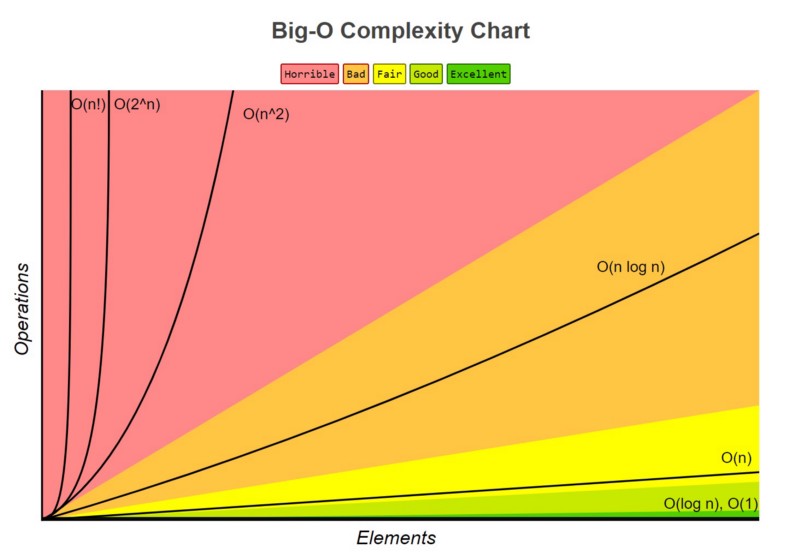
Constant time = O(1)
Logarithmic time = O(log n)
- Binary Search
Linear time = O(n)
- Looping through an array
- Search through linked list
Quasilinear time = O(n log n)
Similar to linear time but with large datasets, it gets progressively worse
- Quicksort
- Mergesort
- Heapsort
Quadratic time = O(n²)
- Insertion sort
- Selection sort
- Bubble sort
Factorial time = O(n!)
- Travelling salesman problem